 By Russ Cohen
Here is the conversation Russ Cohen and Jason Bukala had about the Toronto Maple Leafs 2026 draft. We only get to three prospects in each. Here are the highlights.
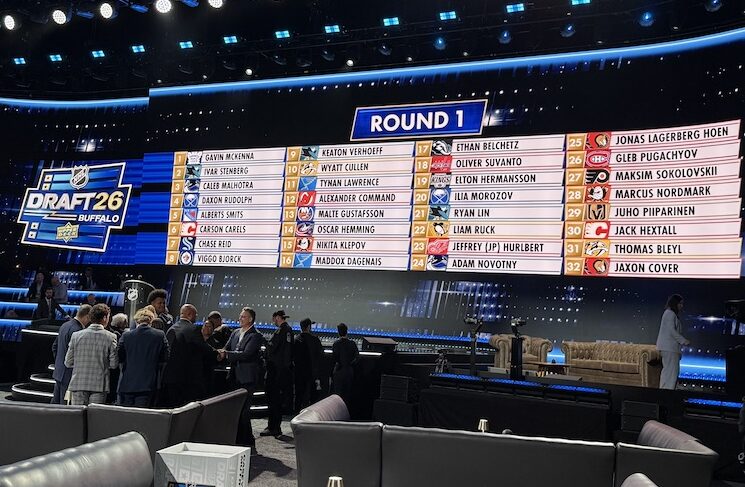
Gavin McKenna
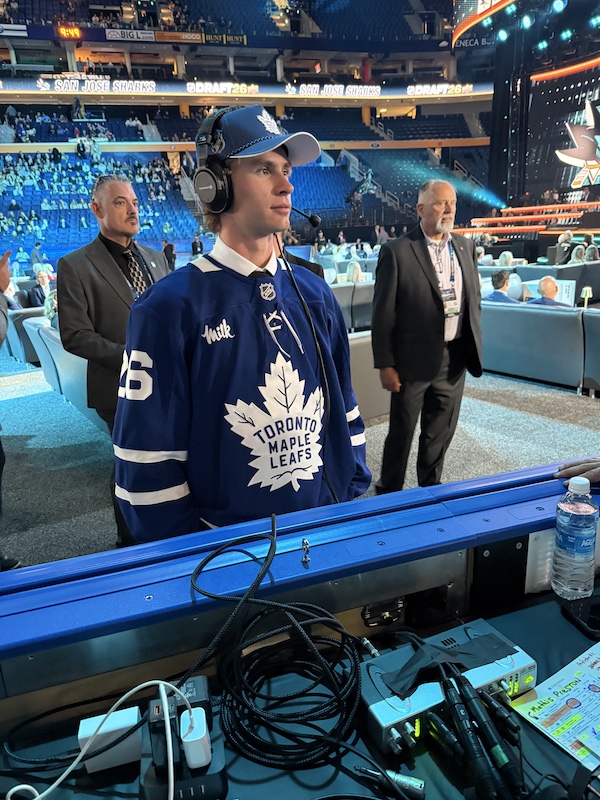
Russ: I think everybody knows him by now. At the draft, he talked about this on air; it was about his outdoor rink, and how cold it used to get, and his mother would have to call him in. And I love that.
Jason: When you grow up in the Yukon, you know, it’s similar to like the kids that grew up in the prairies or northern Ontario, growing up on the outdoor rinks or in northern Quebec, wherever, it’s a tradition, and Gavin McKenna loves to play hockey. I got a lot of pushback from a lot of different circles because I had Ivar Stenberg number one on my list from Christmas on, and it wasn’t. It wasn’t like McKenna didn’t play well enough for me in the second half because he did. His game went to a whole new level. He was actually fantastic. But it was just that the other kid didn’t fall off. The fact that McKenna came to the combine and the condition he came in, the way that he handled himself as a pro, the way that he tested physically in the buildup to the draft, everything about what Gavin McKenna did leading into the combine and then the draft and now development camp with the Toronto Maple Leafs. Boy, oh boy, is he ready to go or what? Like, this kid proved a lot to me, and we already know what he does offensively. You cannot teach that. That’s a God-given ability. He is gifted. There’s no question. He looked me right in the eyes. I broke down some film with him at the combine because we had an interesting conversation, and I was pointing out some games that I was at in person. One was when Penn State was at Michigan State. Another one was when they were playing Wisconsin, and the difference between his game at the beginning of the year, off the puck, tracking back defensively, and, you know, killing plays by being above the play when they don’t have control of the puck. The difference between the beginning of the year and the end of the year was exponential. His growth was fantastic.
Russ: The other thing is, let’s just chat for a second. Penn State was not a good offensive team. So, like, that held him back, I think, a little bit at the early part of the season, too, until they made some changes in the lineup.
Jason: That’s interesting that you say that. Again, let me put it to you this way. If McKenna was coming in this year compared to last year, with what was going on with the CHL and players coming into the NCAA and everything. I think that if you were coming in this year, you would have seen a different beginning to his season. I think that the program at Penn State was sort of learning how to fit in all these puzzle pieces. That’s an interesting observation by you.
Alexander Bilecki
Russ: He’s a defenseman. I like that he shoots. I think that was a big thing I saw, like 3.4 shots per game, and he always wants the puck.
Jason: He’s a competitive kid. He’s 6-1.5. He’s about 175. He’s going to need to add more weight to his frame. I like his body type. Is he ever going to be a guy that’s going to carry 200, for example? He doesn’t look like that to me. I think he’s really athletic. He’s a great skater. I like his brain. I like his competitiveness. He contributed a secondary layer of offense on a Kitchener team that won the Memorial Cup. I mean, you know, they were loaded at the top. He wasn’t called upon to be a guy that needed to produce offense necessarily, but he had 9 goals and 20 assists. That’s nothing to sneeze at, and he pushes back physically. At the Memorial Cup and specifically at the end of the year in Kelowna, I really thought that you had to watch closely, but tracking back and killing plays defensively, being engaged defensively, moving pucks efficiently. There’s a lot to like about Alexander. He could end up being a middle-pairing D in time in the National Hockey League. He contributed a secondary layer of offense on a Kitchener team that won the Memorial Cup.
Ethan McKenzie
Russ: He’s going to have an interesting path. He’s going to be in North Dakota. 1.37 hits per game. That’s pretty good. 5.4 shots per game. Really good on the power play. I like his one timer, and he’s got some pushback.
Jason: Late bloomer. This is a great story as well. He’s 19 years old. He’s going to be turning 20 here in the fall in September. He’s a kid that benefits from the CHL rule to go to the NCAA. He needed more runway, Russ. This is a guy that, if he would have gone through the draft or if somebody had strategized things differently. Imagine it this way. There was no NCAA agreement, so CHL players like this would have to get signed right away by that team. You know what I mean? They would say, okay, we’re drafting you at this stage. We’re gonna sign you. Because if he goes back, if he goes back and he goes through the draft and he goes back to play like an overage year in the Western Hockey League. The fact he’s got a runway ahead of him, and he’s going to a great college program. He showed at the World Juniors at Christmas time for Team Canada that he can be thrust in a variety of roles. 22 goals in 59 games. You’re right. Like he shoots the puck. He had 10 goals on the power play. I like this kid; he’s on the rise. I’m curious to see how he defines himself. When he gets to the college level and then beyond. You know that there’s some offense in there. You know that there’s awareness defensively, and he’s a man already at 6-1, 190 pounds.
Russ: What do you think about their draft as a whole?
Jason: I thought they had a great draft. I really did. I thought that from top to bottom, we just talked about it at the top, but the star power, McKenna, what Bilecki and McKenzie are going to bring, and then you start getting into other players, like, they drafted a kid in with their 4th pick, Zach Olsen, out of Saskatoon, and not only does he produce secondary offense, he’s hard to play against.